
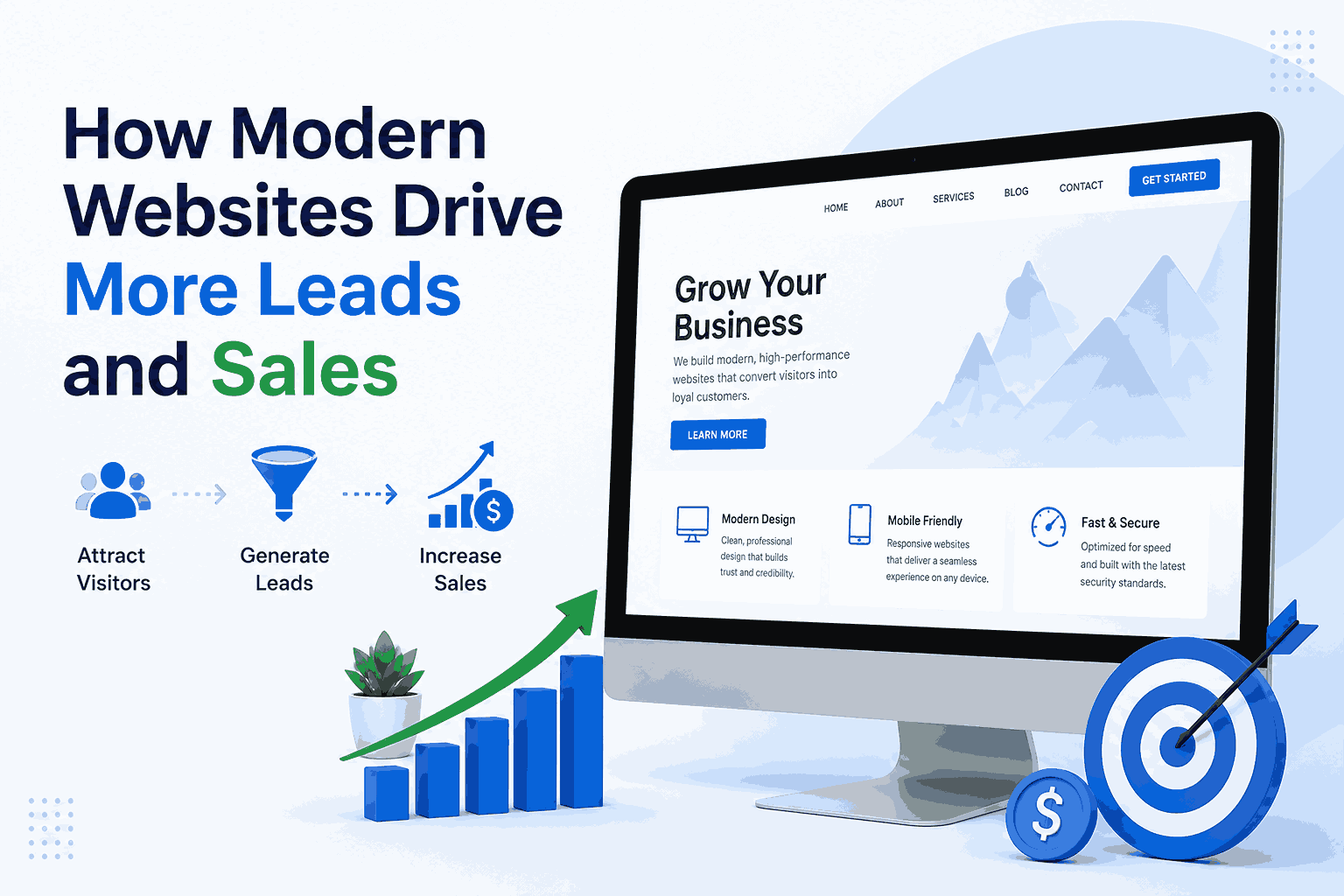
How Modern Websites Drive More Leads and Sales
A website today is far more than a digital brochure, it's a 24/7 sales engine. In a world where customers research, compare, and often decide to buy before ever speaking to a salesperson, your website is frequently the single most important factor in whether a visitor becomes a lead or a customer. Modern websites are built with intention: every design choice, every line of copy, and every button placement is engineered to guide visitors toward action.
In this blog, we'll break down exactly how modern websites are designed to generate more leads and drive more sales, and what your business can do to keep pace.
1. Speed and Performance Matter More Than Ever
Page load speed directly impacts conversions. Studies consistently show that even a one-second delay in load time can significantly reduce conversions and increase bounce rates. Modern websites are optimized with compressed images, efficient code, and fast hosting infrastructure to ensure visitors don't leave before the page even finishes loading. Search engines like Google also factor site speed into rankings, meaning a fast website helps you get found and keeps visitors once they arrive.
2. Mobile-First Design Is Non-Negotiable
With the majority of web traffic now coming from smartphones, modern websites are built mobile-first rather than treating mobile as an afterthought. This means responsive layouts, thumb-friendly navigation, and streamlined checkout processes designed specifically for smaller screens. A poor mobile experience is one of the fastest ways to lose a potential customer, no matter how good your product is.
3. Clear, Strategic Calls-to-Action (CTAs)
Modern websites don't leave visitors guessing what to do next. Every page is designed around a clear goal, whether that's booking a call, signing up for a newsletter, or completing a purchase, and CTAs are placed strategically to guide users naturally toward that action. Effective CTAs use action-oriented language, contrasting colors, and are positioned where user attention naturally lands.
4. User Experience (UX) Built Around the Customer Journey
Rather than organizing a website around internal company structure, modern web design maps out the actual customer journey, from initial awareness to final purchase decision. This includes intuitive navigation, logical page flow, minimal clicks to conversion, and eliminating unnecessary friction. When visitors can find what they need effortlessly, they're far more likely to convert.
5. Trust Signals and Social Proof
Modern websites strategically incorporate trust-building elements such as customer reviews, testimonials, case studies, security badges, and client logos. These signals reassure visitors that your business is credible and reliable, reducing hesitation and objections before they even reach out or check out.
6. Personalization and Smart Content
Advanced websites now use data-driven personalization to show different content, offers, or product recommendations based on visitor behavior, location, or past interactions. This tailored experience makes visitors feel understood, increasing the likelihood of engagement and conversion compared to generic, one-size-fits-all pages.
7. SEO-Optimized Structure
A beautifully designed website means little if no one can find it. Modern websites are built with SEO in mind from the ground up, including clean URL structures, optimized metadata, fast-loading pages, and well-organized content hierarchies. This ensures the website attracts organic traffic that's already searching for what the business offers, resulting in higher-quality leads.
8. Integrated Lead Capture Systems
Rather than relying solely on visitors to reach out, modern websites actively capture leads through strategically placed forms, live chat widgets, exit-intent pop-ups, and gated content like free guides or consultations. These systems work in the background to convert passive browsers into actionable leads for the sales team.
9. Data and Analytics-Driven Optimization
Modern websites are never static, they're continuously refined using real user data. Tools like heatmaps, session recordings, and conversion tracking reveal exactly where visitors drop off or hesitate, allowing businesses to make informed design and content adjustments that steadily improve conversion rates over time.
10. Seamless Checkout and Contact Experiences
For ecommerce sites, a simplified checkout process with multiple payment options and minimal form fields directly reduces cart abandonment. For service-based businesses, easy-to-find contact information, simple booking systems, and quick-loading contact forms make it effortless for interested leads to take the next step.
Best Practices to Turn Your Website Into a Sales Engine
- Audit your site speed regularly and optimize images and code.
- Ensure every page has one clear, primary call-to-action.
- Use real customer testimonials and reviews prominently.
- Design for mobile first, then scale up to desktop.
- Continuously test and refine using analytics and user feedback.
- Keep navigation simple and the path to conversion short.
Final Thoughts
The businesses winning online today aren't just the ones with the most traffic, they're the ones whose websites are engineered to convert that traffic into leads and sales. Modern websites combine speed, design, psychology, and data to create seamless experiences that guide visitors naturally toward taking action. If your website isn't actively generating leads and sales, it's likely time to revisit its design, structure, and strategy.
Investing in a modern, conversion-focused website isn't just an upgrade, it's one of the highest-leverage decisions a business can make to grow sustainably in a digital-first marketplace.