Introduction
Every growing business eventually hits the same wall: scattered tools, endless email threads, manual data entry, and teams working from different versions of the truth. Off-the-shelf software solves part of the problem, but rarely fits the way your business actually operates.
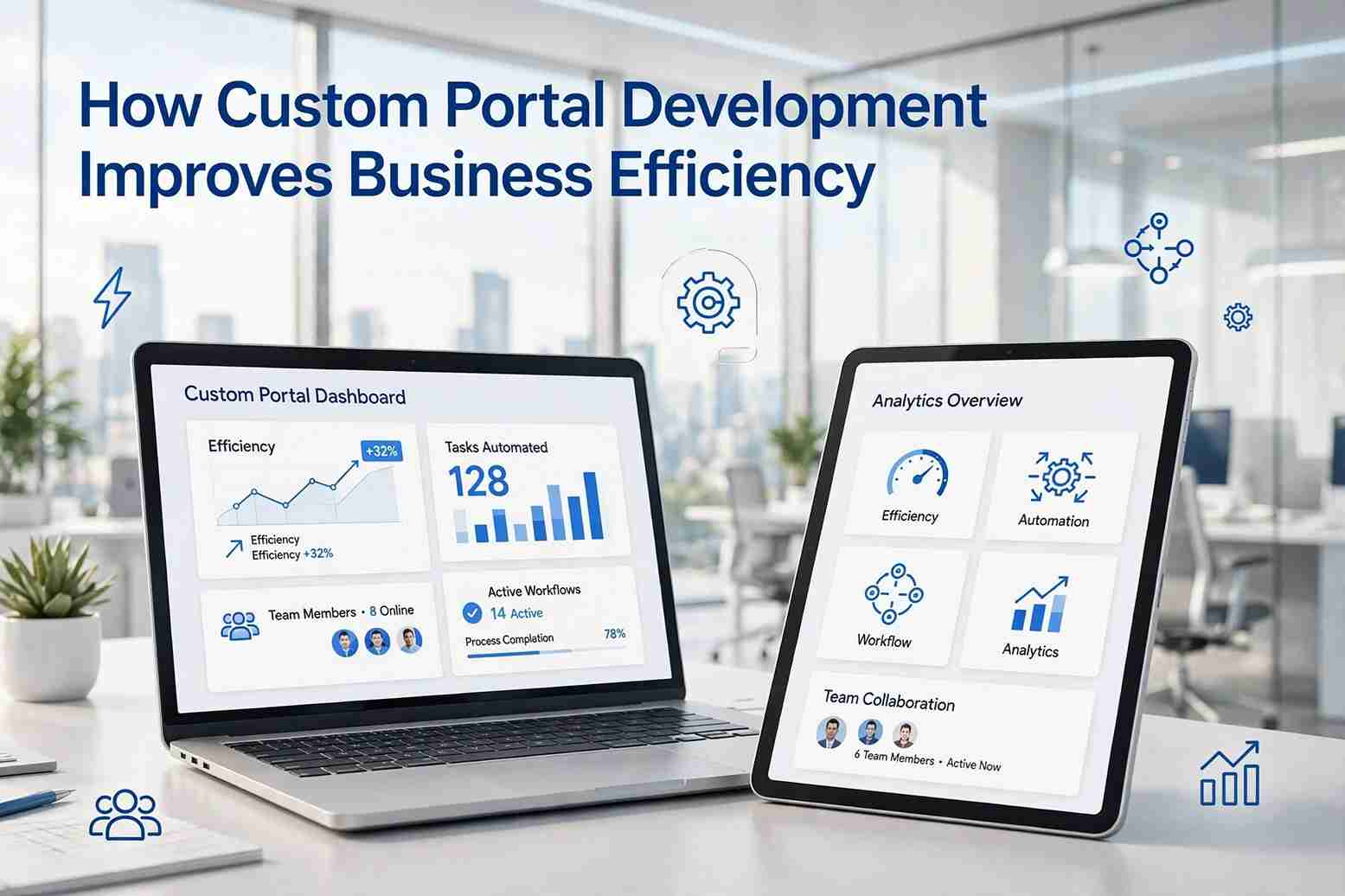
This is where custom portal development comes in. A custom portal is a secure, web-based platform built around your processes, users, and goals. It brings information, tools, and communication into one place, helping teams and customers get things done faster with fewer errors.
In this article, we explore how custom portal development improves business efficiency and why more companies are investing in it.
What Is a Custom Portal?
A custom portal is a tailor-made web application that gives specific users, such as employees, customers, vendors, or partners, controlled access to data, services, and workflows. Common types include:
- Customer portals for self-service, orders, invoices, and support
- Employee portals for HR, internal communication, and task management
- Vendor and partner portals for onboarding, contracts, and collaboration
- Client portals for project updates, documents, and approvals
Unlike generic platforms, a custom portal is designed around your exact requirements, integrations, and brand.
1. Centralizes Information and Tools
When data lives in spreadsheets, inboxes, and separate apps, people waste hours searching for what they need. A custom portal creates a single source of truth.
Documents, reports, dashboards, and communication channels sit in one secure location. Employees spend less time switching between tools, and decisions are made using accurate, up-to-date information. Even small time savings per person add up to significant productivity gains across the organization.
2. Automates Repetitive Tasks
Manual processes such as data entry, approval routing, invoice generation, and status updates are slow and prone to mistakes. Custom portals can automate them through:
- Rule-based approval workflows
- Automatic notifications and reminders
- Auto-generated reports and documents
- Instant data syncing between systems
Automation frees your team from low-value work so they can focus on strategy, customer relationships, and growth.
3. Enables Customer and Partner Self-Service
One of the biggest efficiency drivers is self-service. When customers can track orders, download invoices, raise tickets, or update account details on their own, your support team handles far fewer routine requests.
The benefits are twofold: customers get answers instantly at any hour, and your staff gets time back to solve complex issues. Lower support costs and higher satisfaction often go hand in hand.
4. Integrates Seamlessly with Existing Systems
Most businesses already rely on a CRM, ERP, accounting software, or other internal systems. A custom portal can connect to all of them through APIs, so data flows automatically instead of being re-entered by hand.
This integration removes data silos, reduces duplication, and keeps every department aligned. Instead of replacing your current technology, the portal acts as a smart layer that unifies it.
5. Improves Collaboration and Communication
Efficient teams communicate clearly. Custom portals include features such as shared workspaces, document collaboration, comment threads, task assignment, and real-time notifications.
For client-facing businesses, a client portal replaces long email chains with a transparent view of project progress, files, and approvals. Everyone knows what is happening, who is responsible, and what comes next, which means fewer delays and misunderstandings.
6. Strengthens Security and Compliance
Efficiency should never come at the cost of security. Custom portals let you build in role-based access control, multi-factor authentication, data encryption, and detailed audit trails.
Because the portal is designed for your industry, it can also support compliance requirements such as GDPR or HIPAA. Sensitive information stays protected, and audits become faster because activity logs are already organized and searchable.
7. Provides Real-Time Insights for Better Decisions
Built-in dashboards and analytics turn raw data into actionable insights. Managers can monitor KPIs, track team performance, identify bottlenecks, and forecast demand without waiting for manual reports.
With real-time visibility, leaders can react quickly to issues and opportunities, which is a major competitive advantage in fast-moving markets.
8. Scales with Your Business
Generic software often forces you to adapt your processes to its limits, and costs rise with every new user or feature. A custom portal is built to grow with you. You can add modules, users, integrations, and workflows as your needs evolve, without rebuilding from scratch.
Over time, this flexibility delivers a stronger return on investment than juggling multiple subscriptions that only partially fit.
Best Practices for Successful Portal Development
To get the most from your investment, follow these guidelines:
- Define clear goals. Identify the bottlenecks and KPIs the portal should improve.
- Involve end users early. Employees and customers should shape requirements from the start.
- Prioritize user experience. A simple, intuitive interface drives adoption.
- Start with an MVP. Launch core features first, then expand based on feedback.
- Plan for integration and security. Make them part of the architecture, not an afterthought.
- Choose an experienced development partner. The right team understands both technology and business processes.
Real-World Example
Imagine a distribution company handling orders through phone calls and email. Staff manually enter each order, chase approvals, and answer "where is my shipment?" calls all day. After launching a custom customer portal integrated with its ERP, clients place orders online, track deliveries in real time, and download invoices themselves. Order errors drop, support calls decrease, and the team reallocates its time to sales and service improvement. This kind of transformation is typical when a portal is aligned with real workflows.
Conclusion
Custom portal development is more than a technology upgrade. It is a strategic investment in how your business operates. By centralizing information, automating repetitive work, enabling self-service, integrating systems, and delivering real-time insights, a custom portal removes friction and helps every team work smarter.
If your business is struggling with disconnected tools, slow processes, or growing support demands, now is the time to explore a portal built around your needs. The result is higher productivity, lower costs, and a better experience for everyone who interacts with your company.
Ready to streamline your operations? Partner with an experienced portal development team and turn your workflows into a competitive advantage.