
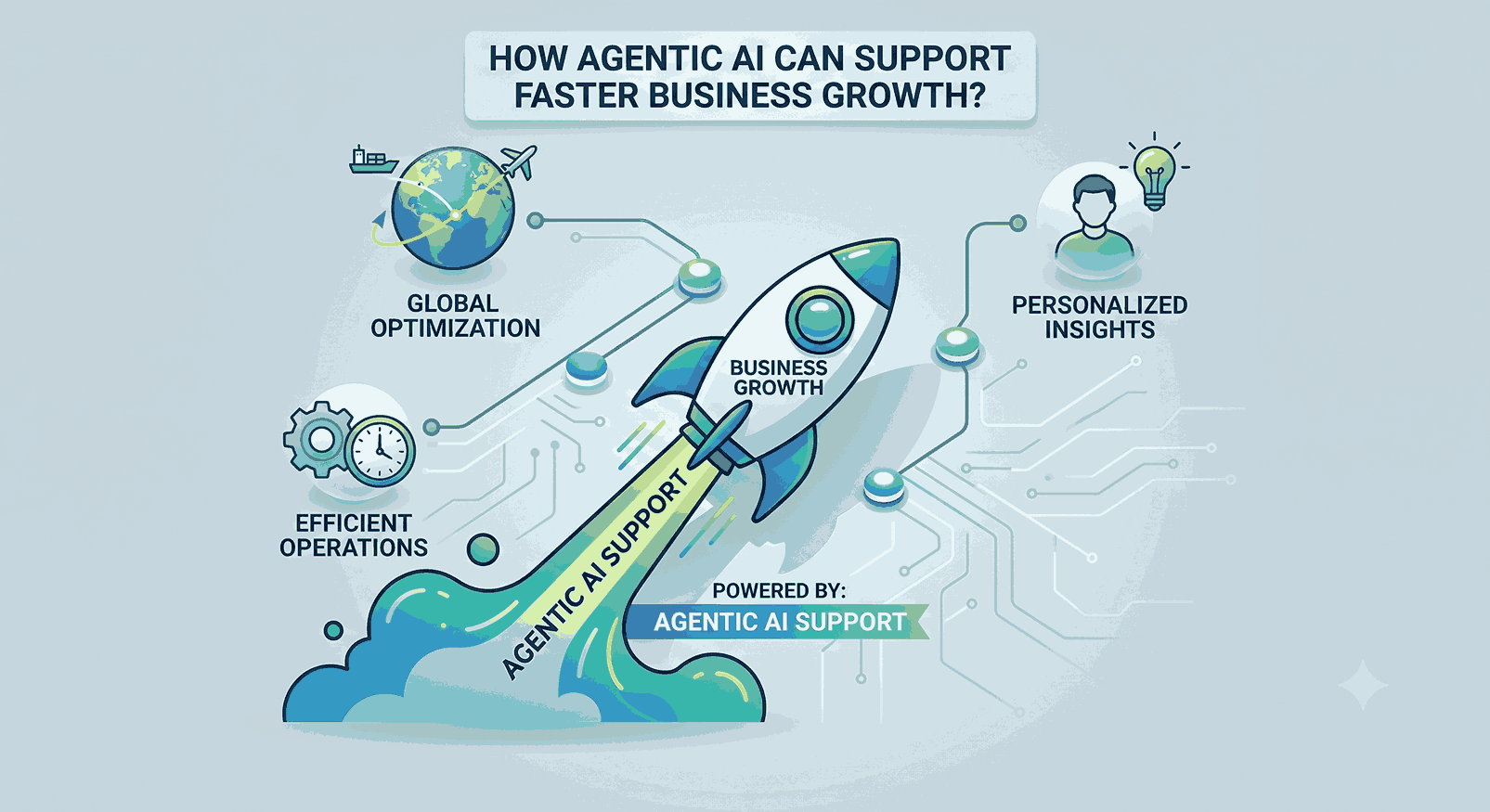
Every business wants to grow faster, but growth is usually bottlenecked by the same constraint: people can only do so much, and hiring takes time. Agentic AI is changing that equation. Unlike traditional automation that follows rigid, pre-set rules, or generative AI that simply responds to prompts, agentic AI can plan, make decisions, take multi-step actions, and adapt in real time to reach a goal. For businesses, that shift means work that once required a human in the loop at every step can now happen autonomously, at scale, and around the clock.
What Makes Agentic AI Different
Agentic AI systems are built around goals rather than single instructions. Give an agent an objective, such as 'qualify this inbound lead and schedule a demo,' and it can independently search for information, use tools, make judgment calls, and complete the task across multiple steps without a person guiding each action. This autonomy is what separates agentic AI from chatbots or simple automation scripts, and it's precisely what unlocks new speed for growing businesses.
1. Accelerating Sales and Revenue Cycles
Sales teams lose enormous time on manual research, follow-ups, and CRM updates. Agentic AI can research prospects, personalize outreach, qualify leads, and even negotiate scheduling, freeing sales reps to focus on closing. Because agents work continuously and in parallel across hundreds of accounts, response times shrink from days to minutes, which directly shortens the sales cycle and increases conversion rates.
2. Scaling Customer Support Without Scaling Headcount
Traditional support scales linearly with customer volume. Agentic AI breaks that link. Support agents can resolve tickets end to end, pull data from multiple systems, issue refunds, update accounts, and escalate only genuinely complex cases to humans. This lets businesses handle growing customer volume with a flat or even shrinking support team, improving both cost efficiency and response time.
3. Speeding Up Operations and Decision-Making
Agentic AI can monitor inventory, pricing, supply chains, or marketing performance continuously, and take corrective action the moment a threshold is crossed, such as reordering stock, adjusting ad spend, or flagging anomalies. Instead of waiting for a weekly report and a manager's decision, the business responds in near real time, compounding small efficiency gains into meaningful growth over a quarter.
4. Enabling Faster Product and Engineering Cycles
In software teams, agentic AI can write code, run tests, debug failures, and open pull requests with minimal supervision. This doesn't replace engineers, but it removes repetitive work from their plate, allowing teams to ship features and fixes faster. For fast-growing companies, shorter development cycles translate directly into a faster path from idea to revenue.
5. Personalizing Growth Marketing at Scale
Agentic AI can build and test marketing campaigns autonomously, from generating audience segments to writing copy variations to reallocating budget toward what performs best. Because agents can run thousands of micro-experiments simultaneously, businesses learn what drives growth far faster than manual A/B testing ever allowed.
6. Reducing the Cost of Scaling
Traditionally, growth requires proportional headcount growth. Agentic AI decouples output from staffing by handling repeatable, multi-step processes autonomously. This lets a lean team support significantly higher volume, which improves margins and gives businesses more room to reinvest savings into further growth initiatives, such as new markets or product lines.
Where Agentic AI Adds the Most Value
- High-volume, repeatable workflows with clear goals but variable inputs, such as lead qualification or support tickets
- Processes that require pulling data from multiple systems before a decision can be made
- Time-sensitive tasks where delay directly costs revenue, such as pricing or inventory adjustments
- Work that scales faster than a team can be hired and trained for it
Getting Started with Agentic AI
Businesses seeing the fastest results typically start with a single, well-defined workflow rather than attempting a company-wide rollout. Choosing a process with clear success metrics, giving the agent access to the right tools and data, and keeping a human checkpoint for high-stakes decisions builds trust in the system before expanding its scope. Once one workflow proves reliable, the same agentic approach can be extended to adjacent processes, compounding the growth benefit across the organization.
Final Thoughts
Agentic AI represents a shift from AI as an assistant to AI as an active participant in getting work done. For businesses focused on growth, that shift matters because it removes the traditional link between scaling revenue and scaling headcount. Companies that identify the right workflows to hand off to autonomous agents today are positioning themselves to grow faster, operate leaner, and outpace competitors still relying on manual processes.