In a digital-first economy, visibility is currency. Businesses that once relied on word of mouth, print flyers, or local newspaper listings now compete in a global marketplace where attention is won or lost within seconds of a scroll. Facebook and Instagram, both owned by Meta, have become two of the most powerful tools for capturing that attention. With billions of combined active users, sophisticated targeting systems, and flexible ad formats, these platforms give businesses of every size a direct line to the customers who matter most. This article explores how Facebook and Instagram ads contribute to measurable business growth and why they remain a cornerstone of modern marketing strategy.
1. Access to a Massive, Highly Engaged Audience
Facebook and Instagram together reach well over four billion monthly active users worldwide. That scale alone makes them attractive, but what truly matters for businesses is engagement. People do not just create accounts and disappear; they browse, comment, share, shop, and message brands directly through these apps. For a business, this means advertising is not shouting into a void, it is placing a message in front of people who are already spending meaningful time on the platform. Whether a company is a local bakery or a global SaaS provider, the sheer size and activity of this audience creates opportunity that traditional advertising channels simply cannot match.
2. Precision Targeting That Reduces Wasted Spend
One of the biggest advantages of Meta's advertising ecosystem is its targeting engine. Businesses can define audiences by age, location, interests, job title, purchasing behavior, and even life events such as a recent move or engagement. Lookalike Audiences take this further by analyzing a business's existing customers and finding new users who share similar characteristics. This precision means ad budgets are spent on people who are genuinely likely to convert, rather than being spread thin across an undefined mass audience. For small and medium businesses with limited marketing budgets, this targeting capability often delivers a return on investment that outperforms traditional print, radio, or television advertising.
3. Visual Storytelling That Builds Brand Identity
Instagram in particular is built around visual content, and Facebook has increasingly adopted the same emphasis through Reels, Stories, and video-first feeds. This visual nature allows businesses to do more than announce a product, they can tell a story. A well-produced Reel, a carousel of before-and-after images, or a Story with a swipe-up link can communicate a brand's personality and values in ways that plain text never could. Over time, consistent visual storytelling builds recognition and trust, two qualities that directly influence a customer's decision to buy. Businesses that invest in quality creative assets tend to see stronger engagement and, ultimately, stronger growth.
4. Flexible Ad Formats for Every Stage of the Funnel
Meta's advertising suite offers formats suited to every stage of the customer journey. Awareness campaigns using video or image ads introduce a brand to new audiences. Consideration campaigns, such as lead generation forms or traffic ads, move interested users closer to a decision. Conversion campaigns, including dynamic product ads and Instagram Shopping tags, push ready buyers straight to checkout. This full-funnel flexibility means a single platform can support an entire marketing strategy, from the first impression to the final sale, without requiring a business to juggle multiple disconnected tools.
5. Retargeting: Turning Interest Into Sales
Most potential customers do not purchase on their first visit to a website or product page. Retargeting, powered by the Meta Pixel and Conversions API, allows businesses to re-engage users who have already shown interest, whether they viewed a product, added an item to a cart, or visited a landing page without converting. These warm audiences typically convert at a much higher rate than cold traffic because the ad is reminding, not introducing. Retargeting campaigns are often among the most cost-efficient parts of a Facebook or Instagram ad strategy, making them a critical driver of incremental revenue.
6. Cost Control and Scalable Budgets
Unlike many traditional advertising channels that require large upfront commitments, Facebook and Instagram ads can start with modest daily budgets and scale as results improve. Businesses can test multiple creative variations, audiences, and placements simultaneously, then shift spend toward what performs best. This kind of budget flexibility lowers the barrier to entry for smaller businesses while still giving larger companies the tools to run sophisticated, high-spend campaigns. The ability to pause, adjust, or scale a campaign in real time also protects businesses from wasting money on underperforming ads.
7. Measurable Results and Data-Driven Optimization
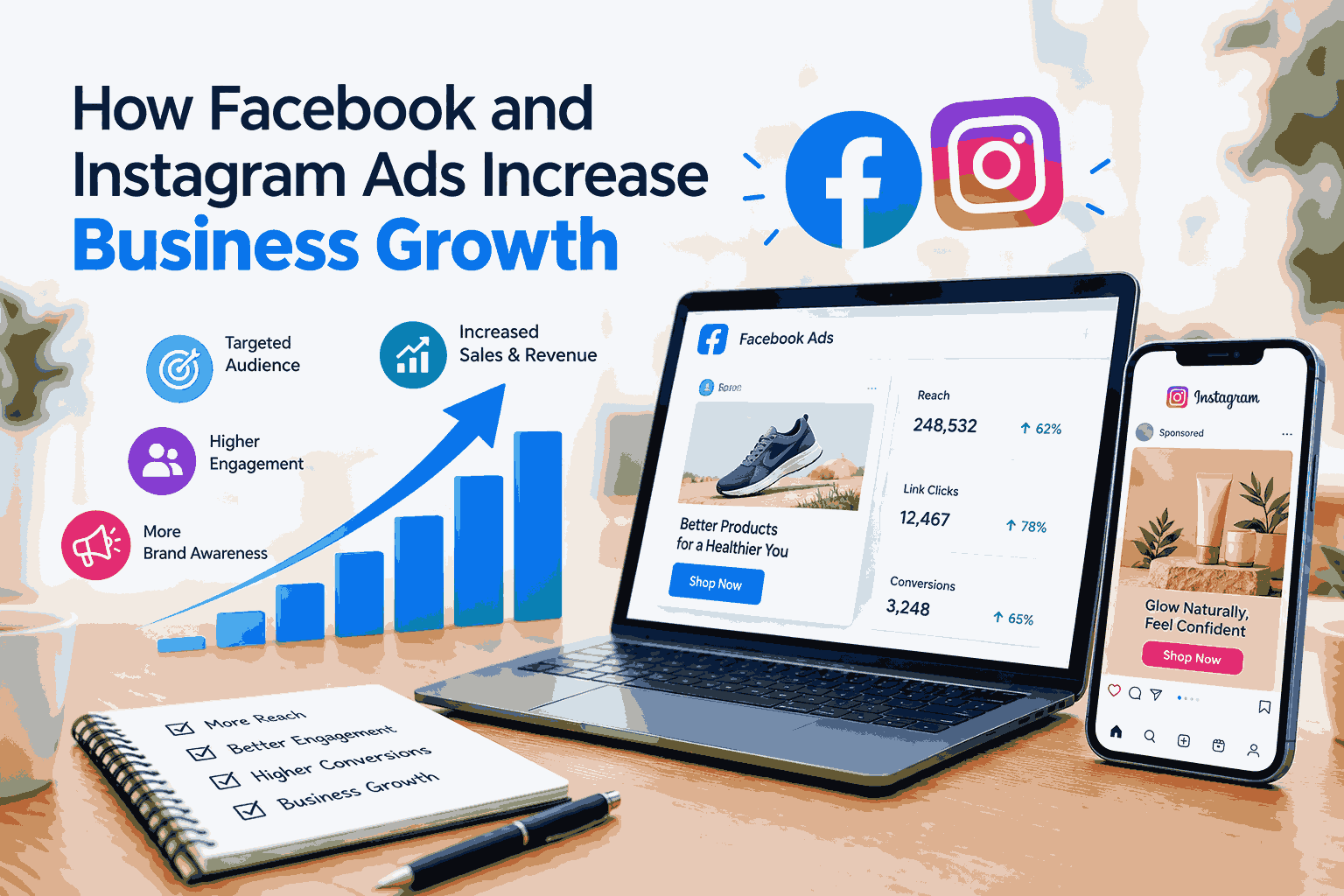
Perhaps the most transformative aspect of Meta advertising is measurability. Every campaign generates detailed data on impressions, click-through rates, cost per result, and return on ad spend. This data allows businesses to make informed decisions rather than relying on guesswork. A/B testing different headlines, images, or calls to action becomes straightforward, and underperforming elements can be identified and corrected quickly. Over time, this feedback loop leads to increasingly efficient campaigns, meaning growth compounds as the business learns what resonates with its specific audience.
8. Driving Local and E-Commerce Growth Alike
Facebook and Instagram ads are equally effective for local businesses and online retailers. Local businesses benefit from geo-targeted ads that drive foot traffic and phone calls, often paired with features like Facebook Local Awareness campaigns or Instagram location tags. E-commerce brands, on the other hand, benefit from Instagram Shopping, product catalogs, and dynamic ads that showcase items a user has already browsed elsewhere online. This versatility means the platforms are not niche tools for one type of business, they are adaptable growth engines for nearly any industry.
Conclusion
Facebook and Instagram ads have reshaped how businesses find, engage, and convert customers. Through massive reach, precise targeting, flexible ad formats, and powerful analytics, these platforms give businesses a level of control and efficiency that was unimaginable in the era of traditional advertising. For companies looking to grow sustainably in a competitive digital landscape, a well-structured Facebook and Instagram ad strategy is no longer optional, it is one of the most reliable paths to measurable, scalable business growth.