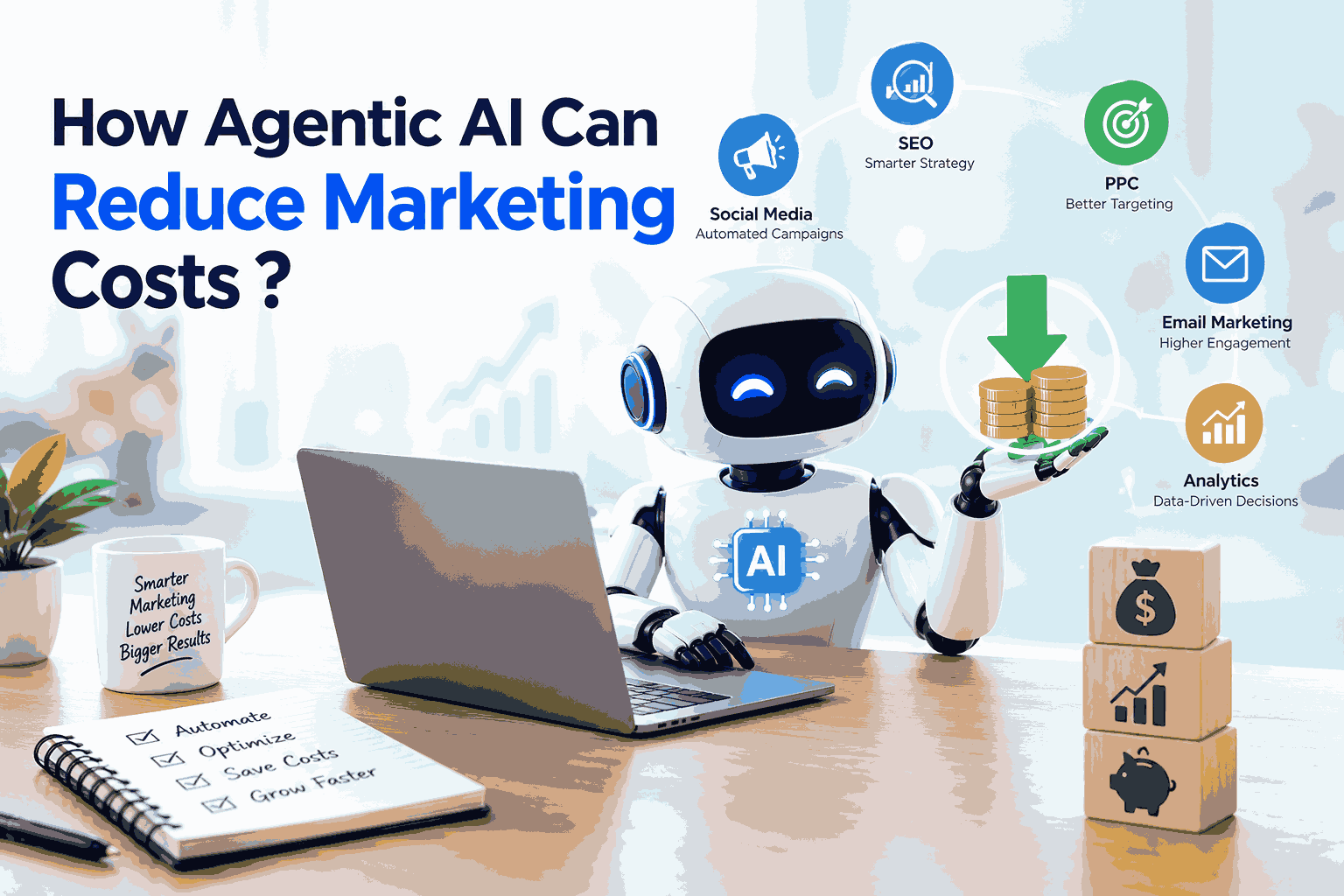
Marketing budgets are under constant pressure. Teams are expected to publish more content, run more campaigns and personalize every interaction, often with the same headcount and a flat budget. Traditional automation helped, but it still needs people to make most decisions.
Agentic AI changes that. Instead of simply following fixed rules, agentic systems can plan, decide and act toward a goal with minimal supervision. In this article, we explore how agentic AI can reduce marketing costs while improving speed and performance.
What Is Agentic AI in Marketing?
Agentic AI refers to AI systems, often called agents, that can pursue a goal on their own. Give an agent an objective such as "lower cost per lead by 15%" and it can analyze data, choose tactics, execute tasks across tools, and adjust based on results.
This is different from a chatbot or a basic automation workflow. A chatbot answers when asked. A workflow runs a preset sequence. An agent reasons about what to do next, uses tools like your CRM, ad platforms and analytics, and keeps improving.
7 Ways Agentic AI Reduces Marketing Costs
1. Automating Repetitive Campaign Work
Campaign setup, audience segmentation, A/B test configuration, UTM tagging and scheduling consume hours every week. Agents can handle these tasks end to end. That frees your team for strategy and creative thinking, and reduces the need to hire for operational work as you scale.
2. Lowering Content Production Costs
Content is one of the largest marketing expenses. Agentic AI can research topics, draft blog posts, adapt them into social posts and emails, and tailor versions for different audiences. Human editors still review for brand voice and accuracy, but the time from idea to published piece drops significantly, and so does the cost per asset.
3. Optimizing Ad Spend in Real Time
Wasted ad spend is a silent budget drain. Agents can monitor performance across channels around the clock, pause underperforming ads, shift budget toward winning audiences, and refresh creative when fatigue sets in. Instead of reviewing campaigns weekly, optimization happens continuously, which helps lower cost per click and cost per acquisition.
4. Personalizing at Scale Without Extra Headcount
Personalized messaging usually improves conversion, but manually creating variations is expensive. Agents can use behavioral and CRM data to tailor emails, landing page copy and offers for each segment automatically. Better relevance means fewer wasted impressions and a higher return on every campaign.
5. Speeding Up Analytics and Reporting
Analysts often spend days pulling data from multiple platforms into reports. An agent can collect the data, spot trends, flag anomalies and write plain-language summaries on demand. Faster insights mean quicker decisions, and fewer hours spent on manual reporting.
6. Qualifying and Nurturing Leads Efficiently
Sales and marketing teams lose time chasing leads that never convert. Agentic AI can score leads, answer common questions, send follow-ups at the right moment and pass only sales-ready prospects to your team. This shortens the sales cycle and lowers the cost of acquiring each customer.
7. Reducing Tool and Agency Dependency
Many businesses pay for several point solutions and outsource routine work to agencies. Agents can consolidate tasks such as reporting, basic copywriting, social scheduling and audience research into one connected system. You can then use agencies selectively for high-value creative and strategy instead of day-to-day execution.
A Practical Example
Imagine a mid-sized e-commerce brand running paid ads, email campaigns and a weekly blog. Today, a team of five manages these manually. With agentic AI, one agent monitors ad performance and reallocates budget daily, another drafts and tests email variations, and a third compiles a weekly performance summary.
The team still sets strategy, approves messaging and manages relationships. But hours once spent on execution shift toward higher-impact work, and the brand can grow output without growing payroll at the same pace.
Challenges to Keep in Mind
Agentic AI is powerful, but it is not a set-and-forget solution. Keep these points in mind:
- Human oversight matters. Review outputs for brand voice, accuracy and compliance, especially for public-facing content.
- Data quality is critical. Agents are only as good as the data they can access, so clean your CRM and analytics first.
- Set clear guardrails. Define budget limits, approval steps and escalation rules before giving agents autonomy.
- Account for upfront costs. Setup, integration and training take time, so savings typically build gradually.
- Protect privacy. Make sure your use of customer data meets regulations such as GDPR and local data laws.
How to Get Started
You do not need to transform your entire marketing function at once. Follow a simple approach:
- Audit your workflows and identify repetitive, time-consuming tasks.
- Start with one high-impact use case, such as ad optimization or reporting.
- Define a measurable goal, like reduced cost per lead or hours saved.
- Run a pilot with human approval at key steps.
- Measure results, refine, then expand to additional use cases.
Conclusion
Agentic AI offers marketers a practical way to do more with less. By automating execution, optimizing spend in real time, scaling personalization and speeding up insights, it can reduce both direct and hidden costs across the marketing function.
The brands that benefit most will be those that pair AI agents with strong strategy and human judgment. Start small, measure carefully, and scale what works. The sooner you begin, the sooner your marketing budget can start working harder for you.