If you've been evaluating an online store rebuild or a new platform this year, you've almost certainly run into the same debate: should you go headless, or stick with a traditional, all-in-one eCommerce platform? It's no longer a niche developer question. In 2026, it's a boardroom question, because the answer shapes how fast your team can ship, how well your store performs, and whether your business is ready for AI shopping agents that are already browsing product catalogs on customers' behalf.
This guide breaks down what each model actually means, where each one wins, and how to decide which architecture fits your business right now.
What Is Traditional eCommerce?
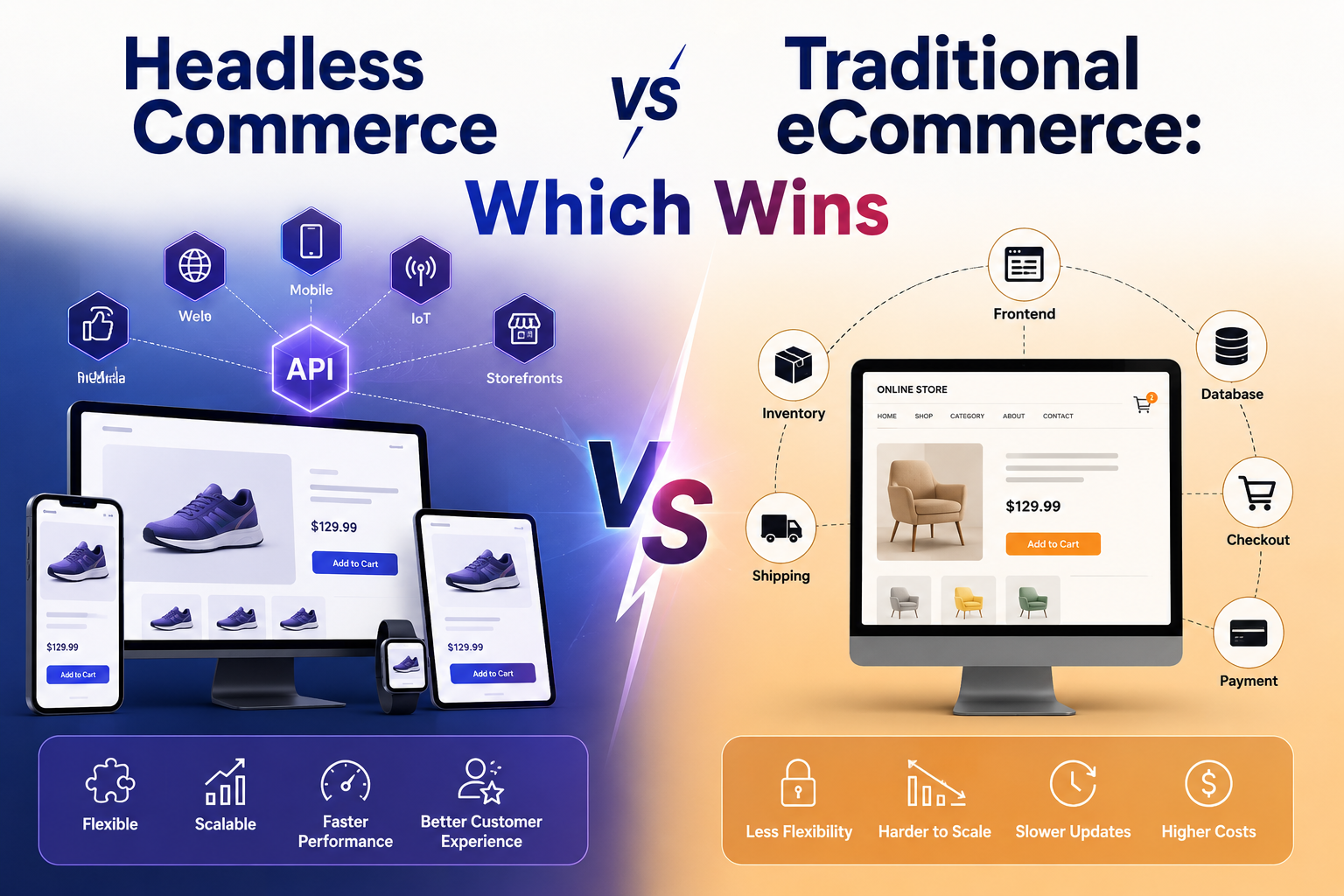
Traditional, or monolithic, eCommerce bundles the storefront (what customers see) and the backend (inventory, checkout, payments, order management) into a single connected system. Platforms like Shopify, WooCommerce, and classic Magento are built this way. You get themes, drag-and-drop editors, and a working store out of the box, often within days.
The tradeoff is flexibility. Because the frontend and backend are woven together, customizing the shopping experience usually means working within the platform's templates and pre-set structures. That's fine for many merchants, but it can become limiting as a brand grows across channels.
What Is Headless Commerce?
Headless commerce separates the frontend presentation layer from the backend commerce engine, connecting the two through APIs. Your team can build a completely custom storefront in React or Next.js while the backend keeps handling orders, inventory, and pricing behind the scenes.
The real payoff is that one backend can power many frontends at once: a website, a mobile app, an in-store kiosk, a voice assistant, or a social commerce channel, all pulling from the same product and pricing data. That decoupling is also why composable commerce, which breaks the backend itself into modular, swappable services, has become one of the defining trends of 2026.
Performance and Speed
Speed is where headless commerce tends to pull ahead. Decoupled architectures can noticeably cut page load times compared to monolithic platforms, with mobile shoppers seeing the biggest gains, since custom-built frontends avoid the bloat of theme frameworks and unused plugins.
That matters more than ever. Independent research from Google has found that a large share of mobile visitors abandon a site if it takes longer than three seconds to load, and that shaving even one second off load time can meaningfully lift conversion rates. For high-traffic or high-AOV stores, that performance gap can translate directly into revenue.
Flexibility, Omnichannel Reach, and AI Agents
Consumer behavior has fundamentally changed. Shoppers now move between websites, apps, marketplaces, and social platforms, often within the same purchase journey. Traditional platforms, built primarily for a single website experience, can struggle to serve every one of those touchpoints well. Headless systems handle this naturally, since APIs can push the same product data to any channel.
There's a newer factor tilting the scale in 2026: AI shopping agents. With tools like ChatGPT's instant checkout, Perplexity Shopping, and Amazon's AI-driven shopping assistants now live, agents are increasingly reading a store's APIs directly rather than rendering its pages visually. A store's commerce API has become as important as its storefront design, and that plays directly to headless commerce's strengths.
Where Traditional eCommerce Still Wins
- Speed to launch: a working store in days, not months
- Lower upfront cost and no need for a dedicated engineering team
- Built-in themes, apps, and support that suit simple catalogs
- Easier ongoing maintenance for small and mid-sized merchants
Where Headless Commerce Wins
- Faster page performance and better Core Web Vitals
- True omnichannel delivery from one backend
- Deeper personalization and creative freedom for marketing teams
- Better readiness for AI agents, voice, and emerging channels
- Independent scaling of frontend and backend under traffic spikes
So, Which One Wins in 2026?
There isn't a single winner, and most credible voices in the space now frame this as a threshold question rather than a binary one. If you're a small or early-stage store with a straightforward catalog and a lean team, a traditional platform still gets you to market fastest and cheapest, and the added complexity of headless commerce usually isn't justified yet.
If you're an established or fast-scaling brand with real traffic, multiple channels, and a team that can support custom infrastructure, headless architecture increasingly looks less like an upgrade and more like the standard. Enterprise adoption backs this up: a large and growing share of enterprise retailers now report using or actively planning to adopt headless commerce, a clear signal of where the market is heading.
The other trend worth watching is the rise of hybrid setups: a traditional backend running most day-to-day operations, paired with a headless storefront on specific high-value surfaces like mobile apps or campaign landing pages. This lets teams capture headless-level performance where it matters most, without re-architecting the entire business at once.
A Quick Decision Checklist
- Do you have (or can you hire) developers to build and maintain a custom frontend?
- Are you selling across three or more channels, or planning to soon?
- Is page speed already hurting conversion or SEO?
- Do you need to support AI shopping agents or voice commerce?
- Can your team absorb higher setup cost and longer launch timelines?
Answering "yes" to most of these points toward headless or a hybrid approach. Answering "no" to most of them means a traditional platform will likely serve you better in 2026, at least for now.
Final Takeaway
Headless commerce wins on performance, flexibility, and future-readiness for AI-driven shopping . Traditional eCommerce wins on speed to launch, simplicity, and cost. The right choice in 2026 isn't about picking the trendier architecture; it's about matching the platform to your traffic, team, and channel strategy, and increasingly, that means blending the two rather than choosing just one.